Systems capability
Fire Control Systems
AS4000 is a modular battlefield management and fire control system for indirect-fire assets, providing C4 capability across command, observer, fire control, meteorological and launcher-management functions up to Brigade Liaison Officer level.
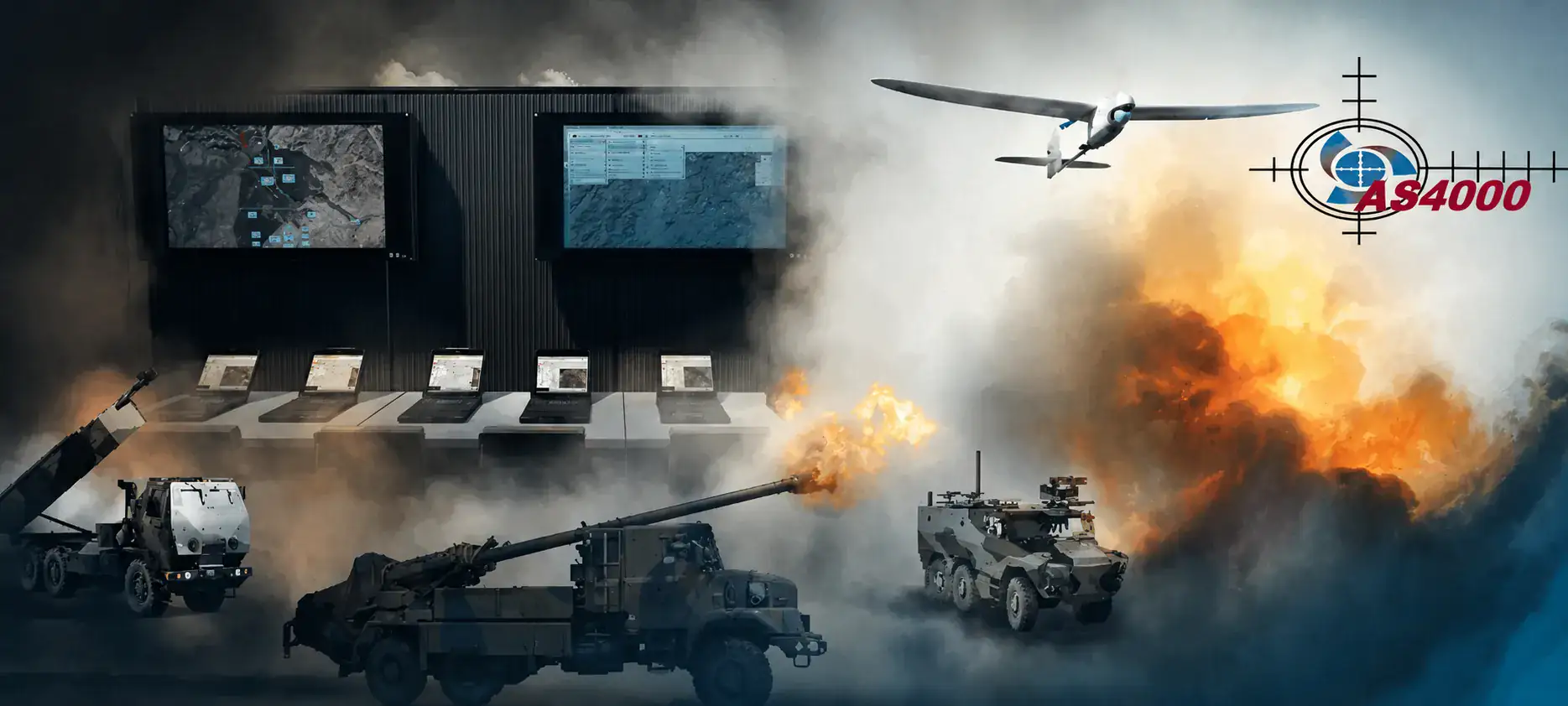
The AS4000 system
What is the AS4000 fire control system?
AS4000 is an integrated battlefield management and fire control system developed specifically for indirect-fire applications. Rather than a single fixed terminal or application, it is a modular family of interoperable capabilities that support different roles within an artillery or mortar organisation.
African Defence Systems configures the AS4000 architecture around the customer’s command structure, weapon platforms, sensors and existing equipment. Depending on the required configuration, the system can support:
- Command and control
- Battlefield management
- Forward observation
- Fire control
- Ballistic calculation
- Launcher management
- Meteorological integration
- Navigation
- Digital communications
- Mapping and situational awareness
At a glance
AS4000 at a glance.
- Product type
- Battlefield Management & Fire Control System
- Primary application
- Indirect-fire assets
- Core capability
- C4, battlefield management and fire control
- Applications
- Command, Observer, Fire Control, Launcher Management, Meteorology
- Ballistics
- Modular ballistic calculation
- Mapping
- Integrated 2D and 3D
- Communications
- Configurable tactical and legacy radio integration
- Sensors
- Compatible existing sensor integration
- Platforms
- Mortar, towed artillery and self-propelled artillery
- Manufacturer
- African Defence Systems
Battlefield management
Integrated command, control and fire capability.
AS4000 connects the information required by command, observation, fire-control and launcher elements within one digital environment. The architecture supports the coordinated flow of operational information between authorised system elements while presenting each user with the information relevant to their role.
This allows fire control to operate as part of a broader battlefield-management capability rather than as an isolated ballistic calculator, providing command, control, communications and computer-enabled coordination (C4) across indirect-fire organisations up to and including Brigade Liaison Officer level.
A common software architecture underpins the AS4000 family. Observer, Command Post and weapon-related functions share the same technology base, delivering interoperability across variants and a consistent operator environment across roles. Configurable interfaces and an established translation mechanism allow the system to be adapted to different organisations and user languages.
Fire control
Ballistics, mapping and fire planning.
Ballistic calculation
Ballistic calculation forms part of the AS4000 fire-control environment, using modular calculations based on the applicable range tables or computer modules. Where supported by the relevant ballistic data, the system can incorporate non-standard conditions such as meteorological information and muzzle-velocity information.
Battlefield mapping and situational awareness
Mapping is integrated into the AS4000 software environment to provide visual context for battlefield-management and fire-control activities. The wider architecture supports both 2D and 3D mapping, presenting own-force, target, fire-support coordination, launcher, movement and navigation information visually rather than through text alone.
Fire planning and engagement management
AS4000 includes engagement setup, engagement management, fire-plan setup, fire-plan editing, execution control, target adjustment and the associated reports and orders within the fire-control software environment. Detailed operational procedures are provided through controlled technical documentation rather than the public website.
Interoperability
Integration built around existing kit.
AS4000 is deliberately architected to integrate with equipment already in service, reducing unnecessary replacement of serviceable capability when a new digital fire-control layer is introduced.
Multi-platform fire control
ADS documentation identifies AS4000 applications covering conventional mortar systems, towed artillery and self-propelled artillery. The architecture supports different indirect-fire organisations and modernisation programmes from a common technology base.
Communications integration
The system is not dependent on one specific radio type. It can be configured around compatible tactical radios, legacy communications equipment and the data interfaces required by the customer environment.
Sensor and subsystem interfaces
Compatible customer-furnished observation and range-finding equipment can be assessed for integration. The wider AS4000 architecture also supports interfaces to data-communication devices, digital radios, launcher-control systems, muzzle-velocity equipment, meteorological systems, inertial-navigation systems and observer sensors — with the final interface architecture defined per programme.
Navigation
Navigation setup and execution can form part of the AS4000 software environment, integrated with other operational information so that positioning and movement data becomes part of the wider battlefield-management picture.
Systems engineering
Hardware, platforms and end-to-end integration.
AS4000 is delivered as a systems-engineering programme rather than a software licence. Depending on the configuration, African Defence Systems provides and integrates the computing platforms, display equipment, communications interfaces, power supplies and the mechanical work required for mounted or dismounted installations on launcher and command vehicles.
Where a programme requires wider integration, AS4000 can operate alongside other ADS capabilities:
- Mortar Optical Heading & Reference Sighting — digital heading and reference for conventional mortar applications.
- Scorpion Automated Mortar System — vehicle-mounted platform combining weapon, fire control, navigation and integration.
- Drone Integration Systems — connecting unmanned systems into the wider information and command environment.
- Communication Systems — mounted, man-portable and specialised communications equipment for defence applications.
Programme fit
Designed around the requirement.
No two fire-control programmes begin with the same equipment, command structure or operational requirement. ADS configures AS4000 around what already exists in the customer environment — current command structure, weapon platforms, existing fire-control equipment, observation sensors, communications, navigation and meteorological capability, existing computing hardware, required level of automation, and mounted or dismounted constraints.
The objective is to build the required capability around the mission rather than force every customer into a fixed configuration. In practice this means AS4000 delivers battlefield management and fire control in one architecture, modular applications for command, observer, fire control and launcher management roles, integrated ballistic calculation and fire planning, digital mapping, meteorological and muzzle-velocity integration, tactical and legacy radio compatibility, and support for both mortar and artillery applications — all from a common AS4000 software base.
Integration & disclosure
Technical detail, shared responsibly.
The public site describes AS4000 at capability level. Detailed system architecture, ballistic information, interfaces, operational procedures and platform-specific specifications are shared through a controlled consultation process with authorised customers and programme partners.
Frequently asked
AS4000 questions.
What is AS4000?
AS4000 is a modular Battlefield Management and Fire Control System from African Defence Systems for indirect-fire assets. It combines command-and-control, observation, fire control, ballistic, communications, mapping and launcher-management capabilities within an integrated architecture.
What does a fire control system do?
Within the AS4000 environment, fire control connects information from command, observation, ballistic, communications and weapon-management functions. The precise capability depends on the system configuration and operational role.
Is AS4000 only for artillery?
No. ADS documentation identifies AS4000 applications for both mortar and artillery systems, including conventional mortars, towed artillery and self-propelled artillery.
Does AS4000 provide battlefield management capability?
Yes. AS4000 combines fire control with battlefield-management functions including mapping, situational awareness, operational information management and command-and-control capabilities.
Does AS4000 calculate ballistics?
Yes. AS4000 supports modular ballistic calculation using the applicable ballistic data or computer modules configured for the system.
Can AS4000 use meteorological information?
Yes. Meteorological systems can interface with the AS4000 environment, and meteorological information can be used in ballistic calculations where supported by the relevant ballistic data or calculation module.
Can AS4000 integrate with existing radios?
Yes. AS4000 is not tied to one specific radio type. Compatible tactical and legacy communications equipment can be assessed for integration according to the required interfaces.
Can existing sensors be integrated?
Yes. Compatible customer sensors, including suitable range-finding and observation equipment, can be evaluated for integration with AS4000.
Does AS4000 include mapping?
Yes. Mapping is a defined part of the AS4000 software environment, including 2D and 3D mapping capabilities within the wider architecture.
Can AS4000 integrate with launcher systems?
Yes. Launcher Management is one of the principal AS4000 applications, and the wider architecture supports interfaces to launcher-control equipment.
Is AS4000 one fixed system configuration?
No. AS4000 is modular. ADS configures the required combination of capabilities according to the customer’s command structure, weapon platforms, sensors, communications and operational requirement.
Does ADS provide the hardware as well as the software?
Yes. African Defence Systems’ capability includes fire-control software, computing hardware, communications interfaces, subsystem integration, power solutions and mechanical integration on launcher and command platforms.